Description
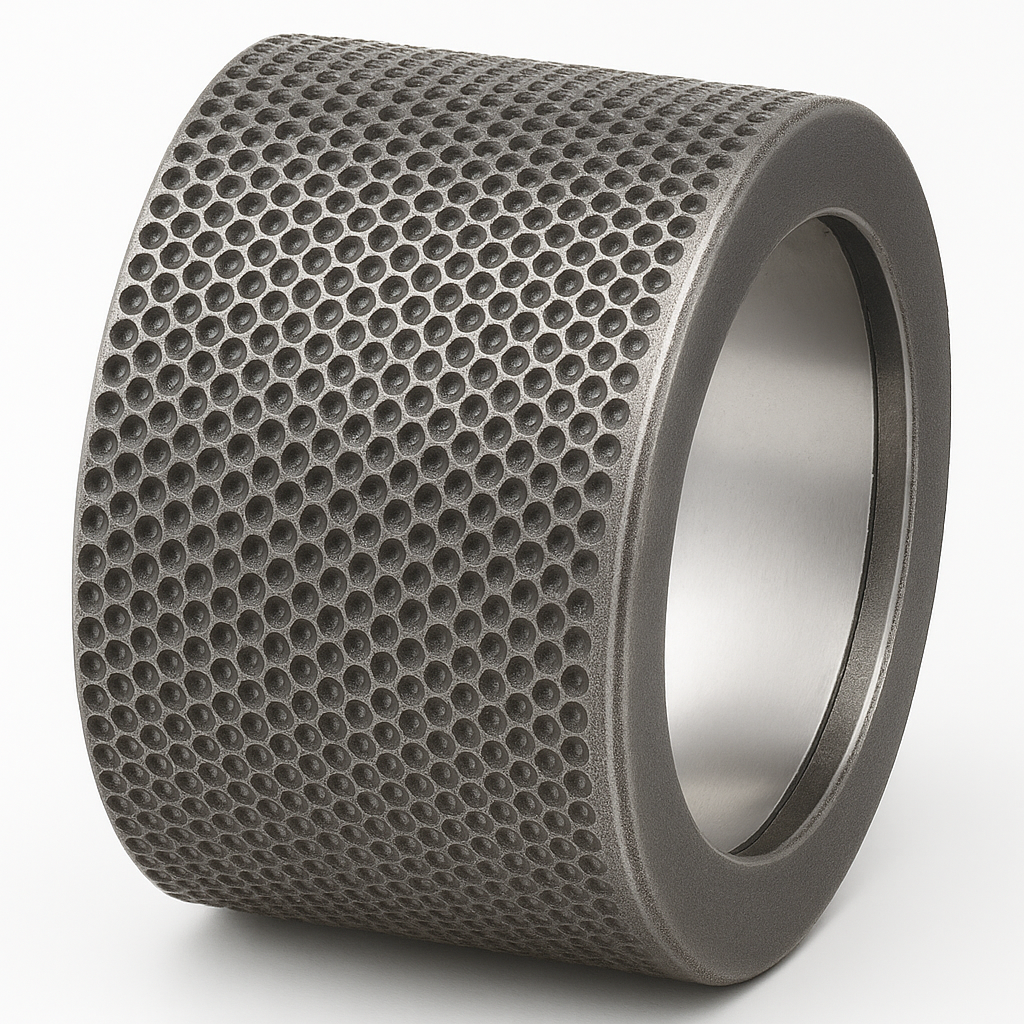
The horizontal diamond hole arrangement roller shell is a discrete surface design for pellet mill rollers, featuring circular or elliptical blind holes/through holes arranged in a horizontal diamond array (with the diamond’s long axis oriented circumferentially) on its working face. Unlike vertical diamond hole arrangements, the horizontal diamond pattern creates circumferentially staggered hole positions, generating both circumferential material tumbling and axial effects as the roller rotates. This design applies gentle kneading and mixing to the material during compression while avoiding the excessive fiber shearing caused by continuous groove patterns. It is particularly suitable for medium-viscosity materials that require uniform mixing without damaging particle structure, such as fermented feeds, premixes, and certain chemical raw materials.
The core advantages of the horizontal diamond hole arrangement roller shell are threefold: First, the discrete hole array eliminates continuous stress concentration zones, giving the roller significantly better fatigue life than continuous groove types. Second, the momentary pressure relief provided by the hole areas effectively expels entrapped air from the material, improving pellet density. Third, the unique circumferential material tumbling effect of the horizontal diamond arrangement promotes micro-scale mixing of different components, improving pellet composition uniformity. This design is particularly suitable for operating conditions with low ring die speeds and longer material residence time in the compression zone.
Selection guidelines: Hole diameter (φ3-8mm), hole depth (1.5-4mm), and hole spacing (wall thickness 2-4mm) should match material characteristics. Use small-diameter, shallow holes for fine powders; use large-diameter, deep holes for coarse fibrous materials. High-chromium cast iron or powder metallurgy steel is recommended, with R-radius at hole bottoms to prevent fatigue cracking. Maintenance focus includes monitoring land wear between holes and plastic deformation at hole edges.